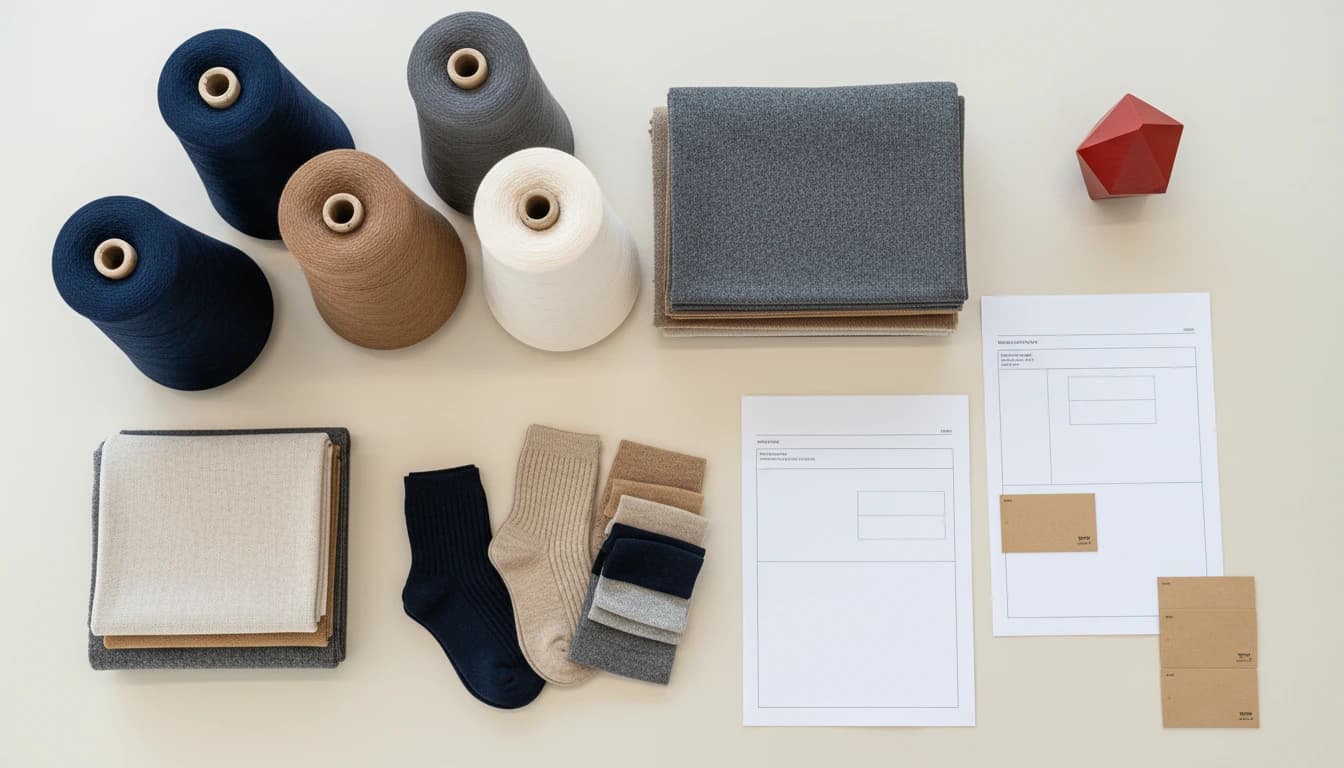
Sourcing guide
Custom sock MOQ: understanding minimum order quantities before you commit.
Most MOQ confusion comes from treating the number as a fixed factory rule. In practice, minimum order quantities shift depending on yarn composition, construction complexity, packaging scope, and whether the buyer needs one colorway or a multi-SKU assortment.

Order minimums shift with yarn type, construction method, colorway count, and packaging presentation. Understanding the inputs helps buyers plan smarter.
Program board
Lock the channel, quantity band, and packaging shape before the first quote.
Learn how custom sock MOQs work across product types, materials, packaging options, and program scales. Make informed sourcing decisions before your first quote request.
The minimum is not one number — it depends on what you are building.
A simple single-color crew sock with poly-bag packaging carries a different floor than a multi-color jacquard build with custom gift boxes. The buyer can influence the MOQ by adjusting complexity early.
Adjust these inputs to manage your minimum order quantity.
Buyers who understand which levers affect MOQ can plan their programs to hit achievable floors without overcommitting.
Typical MOQ bands for common program types.
These are guide ranges, not fixed rules. The actual floor depends on the full brief — product type, material, packaging, and timeline all factor in.
MOQ is a conversation about scope, not a fixed price tag.
Minimum order quantities shift depending on yarn, construction, colorways, packaging, and sizing. Buyers who understand these levers can plan achievable programs without overcommitting.
- First-time buyers trying to understand what quantity commitment is realistic
- Teams comparing product complexity against budget and volume constraints
- Programs that need to balance MOQ against packaging and presentation ambitions
Production lens
Make the route specific before the first quote gets too broad.
Start with one product direction
A single-style, single-colorway order has the most predictable MOQ floor. Multi-SKU assortments are still accessible but carry per-SKU minimums.
Use packaging as a complexity dial
Simpler packaging keeps the effective MOQ lower. Moving to retail-grade packaging increases the floor because setup and materials expand.
Quantity bands matter more than exact floors
Quoting in realistic bands helps both buyer and factory scope the order honestly without false precision.
Lower MOQ vs. unit economics
Reducing order volume usually raises per-unit cost and limits material and packaging options. The best approach is to adjust complexity to fit the quantity band.
RFQ evidence
Send the inputs that prove this route is ready for a production reply.
- Product type, material preference, and construction complexity
- Number of colorways or SKUs in the first order
- Packaging tier: bulk, simple wrap, retail, or gift
- Timeline and whether repeat orders are expected
How MOQs work
The minimum is not one number — it depends on what you are building.
A simple single-color crew sock with poly-bag packaging carries a different floor than a multi-color jacquard build with custom gift boxes. The buyer can influence the MOQ by adjusting complexity early.
Standard cotton or blended socks
Typically the lowest MOQ band. Straightforward yarn, established knit patterns, and simpler packaging keep the floor accessible for first-time buyers.
Performance and specialty builds
Cushion zones, arch compression, moisture-wicking yarns, or grip pads raise the floor because setup and material sourcing require more commitment.
Multi-SKU assortments
Per-SKU MOQs are usually lower than a single-product run because the overall order volume justifies setup across multiple styles.
What moves the floor
Adjust these inputs to manage your minimum order quantity.
Buyers who understand which levers affect MOQ can plan their programs to hit achievable floors without overcommitting.
- Yarn type: commodity cotton vs specialty blends like merino or bamboo
- Construction: flat-knit logos vs full-coverage jacquard patterns
- Colorway count: single vs multi-color affects yarn loading
- Packaging: poly-bag, sleeve wrap, hang tag, gift box — each changes the production path
- Sizing: single vs multi-size runs multiply the SKU count
Practical ranges
Typical MOQ bands for common program types.
These are guide ranges, not fixed rules. The actual floor depends on the full brief — product type, material, packaging, and timeline all factor in.
Promo and event socks
Lower-complexity builds with simpler packaging. Usually the most accessible entry point for first-time buyers testing the market.
Retail and private-label runs
Mid-range complexity with presentation packaging. MOQ reflects the need for consistent quality and retail-ready finish.
Specialty and performance programs
Higher setup investment for technical yarns and construction. The floor reflects material sourcing and QC requirements.
Frequently asked questions
Clear the keyword-level objections before the buyer leaves the page.
Can I order fewer than the typical MOQ?
Sometimes, but reducing below practical floors usually increases per-unit cost and limits material or packaging options. It is better to adjust complexity to fit your quantity band.
Does packaging affect the MOQ?
Yes. Moving from poly-bag to retail packaging (sleeve wraps, hang tags, gift boxes) can raise the effective minimum because packaging setup and materials add to the production path.
How do I lower my MOQ without losing quality?
Simplify the build: fewer colorways, standard yarn blends, simpler packaging, and a single size run all help bring the floor into reach.
Need a concrete next step?