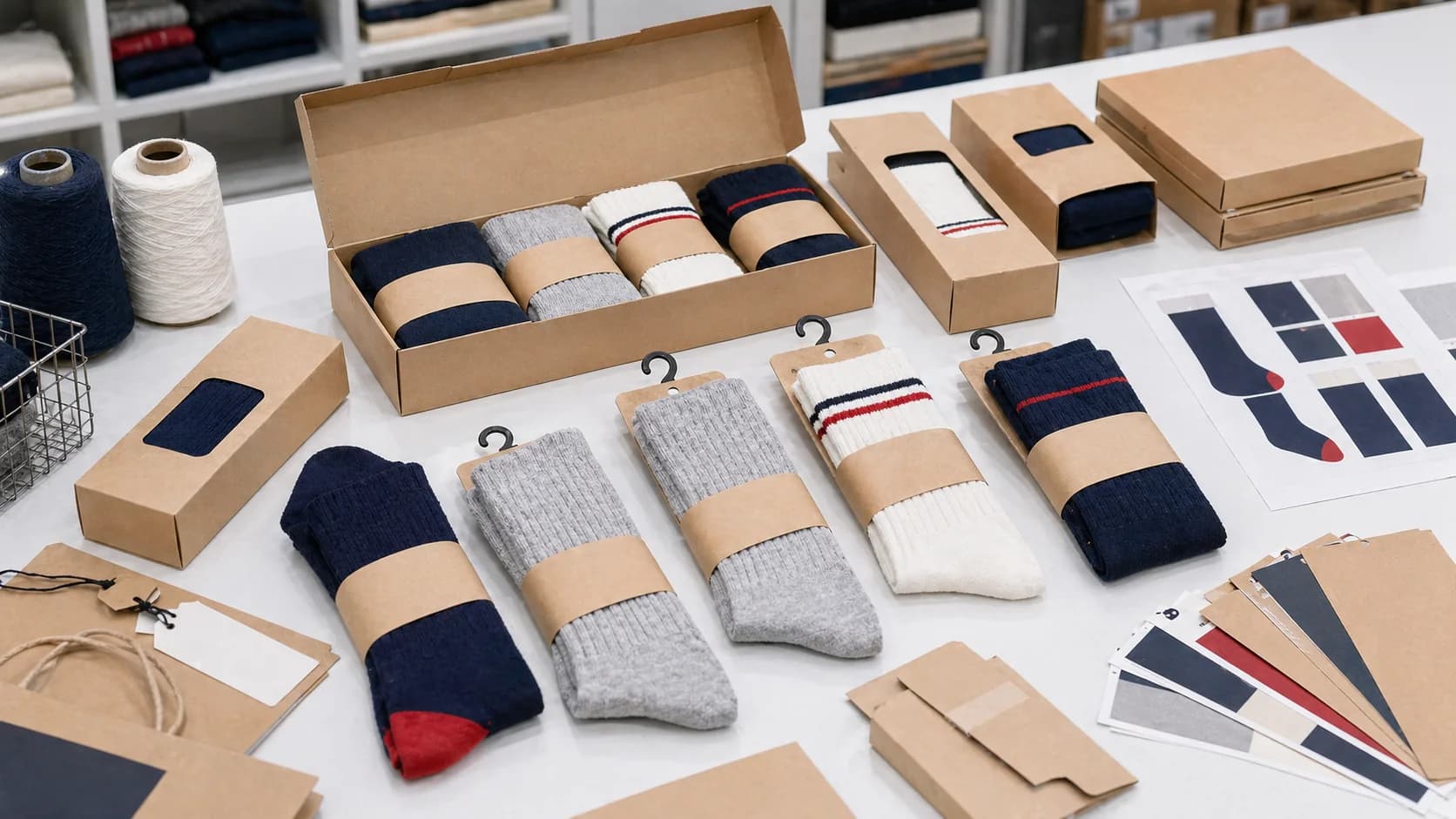
Private label socks manufacturer for retail packaging and fit.
Buyers searching for a private label socks manufacturer are usually trying to decide whether the sock, packaging, label system, fit, and first assortment can become one sellable product family.
What should a private label socks manufacturer help decide?
A private label socks manufacturer should help the buyer shape the sock, packaging layer, label system, fit logic, and assortment plan as one commercial product. A strong first RFQ names the target channel, quantity band, material direction, packaging tier, price position, and repeat-order expectation before adding SKU complexity.
Signal 01Retail-facing and boutique-ready private label programsSignal 02Packaging architecture scoped from the first reviewSignal 03Repeatable assortment logic for growing brands
Private label packagingA private label program should feel finished on shelf
Private label socks work best when product, wrap, tag, and carton choices are treated as one commercial package.
Program board
Lock the channel, quantity band, and packaging shape before the first quote.
Private label socks for retail and gifting buyers that need packaging-ready product direction, fit logic, label planning, and assortment control before RFQ.
Program structureWhat to align earlyWho this fitsSample and approval logicDepth passWhat this is not
Private label is a packaging and presentation problem as much as a sock problem.
The sock itself may be simple. What changes perceived value is whether the buyer decides early on sleeve wraps, tags, cartons, and assortment logic.
Stage 02
Private label friction usually comes from late packaging decisions.
If the product has to look premium, the packaging call should happen before sampling drifts too far. It affects approvals, inserts, carton assumptions, and perceived margin room.
Stage 03
Private label works best when the buyer cares about the system, not just the sock.
The strongest private label programs are trying to create a repeatable branded product line with consistent presentation, packaging, and assortment logic.
Commercial sock product route
Private-label sock route
Use private-label socks when product, label, wrap, carton, and assortment logic need one owner.
Decide whether the first launch should prove a narrow repeatable system before SKUs and packaging layers expand.
Bring product family, first assortment, label or wrap needs, carton expectation, quantity band, destination, and launch timing into the private-label RFQ.
Keep product family, channel, material, packaging, sample path, destination, and RFQ evidence inside the same custom sock program route.
Route fit
Use this as a production-ready custom sock route, not a loose catalog choice.
SaySock keeps each commercial route tied to buyer intent, pack-out pressure, sampling assumptions, destination context, and the evidence needed for a useful first production reply.
Private-label sock product system for buyers who need packaging, fit, label content, and assortment logic together.
State this as a buyer-channel request before pricing is discussed.
Use the route boundary: factory-led packaging and product direction.
Separate this request from adjacent routes such as Use boutique retail socks for small shelf assortments, Review packaging options for private-label socks, Check MOQ before expanding the assortment.
Route boundary
Keep the first production reply specific.
This route should stay focused on factory-led packaging and product direction, so the RFQ does not blur into nearby product, channel, or operating-model pages.
Next move
Bring the clearer statement into the RFQ.
Bring factory-led packaging and product direction, quantity band, packaging expectation, target channel, and deadline into the RFQ.
Route fit check
factory-led packaging and product direction
Private-label sock product system for buyers who need packaging, fit, label content, and assortment logic together.
buyer-channel
Use boutique retail socks for small shelf assortments
Boutique routes narrow the private-label idea into smaller retail-ready drops.
Private label is a packaging and presentation problem as much as a sock problem.
The sock itself may be simple. What changes perceived value is whether the buyer decides early on sleeve wraps, tags, cartons, and assortment logic.
Program structure
Brand-led retail drops
These need stronger packaging cohesion and more attention to how the line will read inside a product family.
Program structure
Gift and bundle assortments
Here the private label value often comes from how well the sock integrates into a larger kit or retail set.
Program structure
Repeatable seasonal programs
These benefit from a product framework that can absorb new colorways or themes without rebuilding the whole system.
What to align early
Private label friction usually comes from late packaging decisions.
If the product has to look premium, the packaging call should happen before sampling drifts too far. It affects approvals, inserts, carton assumptions, and perceived margin room.
Choose whether the launch is bulk, wrapped, tagged, or carton-packed
Decide if the label system needs to scale across several SKUs
Align size planning with actual market fit instead of generic ranges
Use yarn and texture choices that match the expected price point
Who this fits
Private label works best when the buyer cares about the system, not just the sock.
The strongest private label programs are trying to create a repeatable branded product line with consistent presentation, packaging, and assortment logic.
Who this fits
Boutique and design-led retail
Good fit when product presentation and packaging discipline affect perceived value on shelf.
Who this fits
Growing branded assortments
Useful when the buyer needs a structure that can support repeat launches without reinventing every element.
Who this fits
Gift-led private label
Strong when the product needs to land as a finished branded item inside a broader set or seasonal collection.
Sample and approval logic
Private label friction usually comes from trying to approve presentation too late.
Sampling gets cleaner when the buyer decides how premium the product should feel before the pack-out and label discussion starts drifting.
Set the target price point and expected product feel early
Decide what packaging layer actually belongs in the first launch
Use the first sample to test product direction, not to solve every future SKU
Keep carton and shipment assumptions attached to the same approval thread
Depth pass
Make the product system visible before adding more SKUs.
The buyer objection is usually whether private label will create too much packaging work before the first sell-through signal. The page should keep the first system narrow enough to approve and broad enough to repeat.
Depth pass
Buyer objection: private label may overbuild the first launch
A useful private-label page should show how to start with a controlled family before adding extra wraps, labels, and variants.
Depth pass
Decision trigger: packaging and assortment need one owner
Use this route when the sock, wrap, tag, carton, and first assortment must be reviewed as one product system.
Depth pass
RFQ readiness: send the shelf plan before the SKU list expands
The first reply needs target channel, packaging layer, size logic, price position, and repeat expectation before colorways multiply.
What this is not
Private label is not just a bigger logo with a nicer wrap.
If the buyer is not trying to build a product system, the simpler custom logo route may be stronger than over-scoping the launch as private label.
Not the best fit for one-off category experiments with no packaging need
Not the best fit when the buyer only wants the simplest possible bulk merch run
Not the best fit when assortment, packaging, and market position are still completely open
Frequently asked questions
Clear the keyword-level objections before the buyer leaves the page.
What makes private label socks different from standard custom socks?
Private label usually means the buyer is shaping the branded product system more intentionally, including packaging, presentation, and assortment continuity.
Can a private label program start small?
Yes. It is often smarter to start with a narrow assortment and clean packaging logic, then expand once the first sell-through signal is clear.
When should packaging be decided?
As early as possible. Packaging affects how the product will be sampled, presented, and shipped, so late changes tend to slow everything down.
Need a concrete next step?
Send the quantity, channel, and packaging need. We will narrow the build fast.