Sourcing guide
Cotton vs performance socks: choosing the right material for your program.
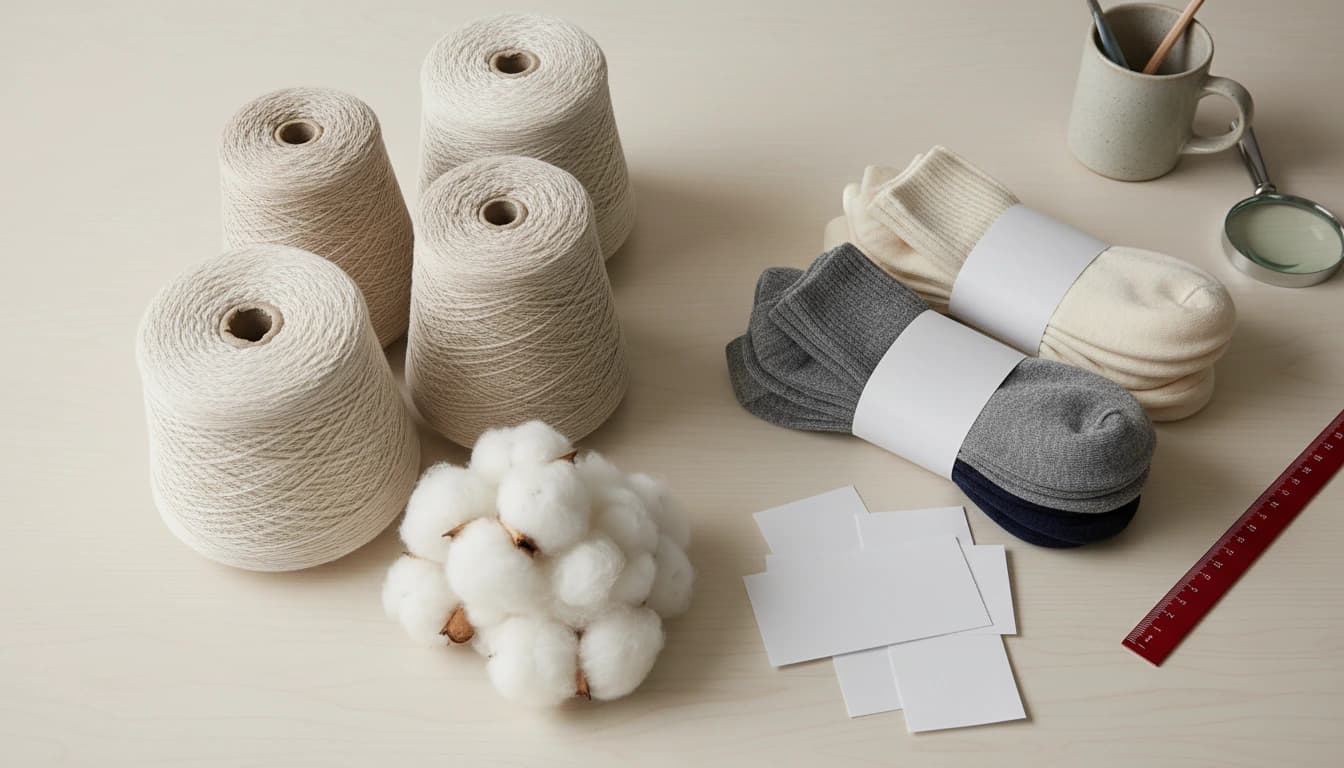
Material choice is one of the first decisions that shapes everything else in a custom sock program — cost, feel, durability, packaging, and even the target buyer. Getting it right early prevents expensive sample loops and mismatched expectations.

Yarn selection affects knitting behavior, color output, hand-feel, durability expectations, and cost per unit. Choosing well at this stage saves rework later.
Program board
Lock the channel, quantity band, and packaging shape before the first quote.
Compare cotton and performance sock materials for custom programs. Understand how material choice affects comfort, durability, cost, MOQ, and buyer perception across different use cases.
Cotton socks work best when comfort and familiarity drive the buyer decision.
Cotton is the most understood sock material. It feels familiar, takes color predictably, and communicates quality to buyers who associate natural fibers with premium products.
Performance materials earn their place when the sock needs to do real work.
Synthetic and technical blends offer moisture management, compression, cushioning, and durability that cotton alone cannot match — but they cost more and require more intentional positioning.
Let the end use case guide the material, not the other way around.
The most common mistake is choosing a material based on personal preference instead of the program's actual channel and buyer expectation.
Material choice shapes the product, the price, and the buyer expectation.
Cotton and performance materials serve different use cases. The buyer should choose based on the end wearer's context, not material preference alone.
- Buyers comparing cotton-led comfort against performance-led functionality
- Teams deciding material direction before the first sample request
- Programs where the sock material must match channel and wearer expectations
Production lens
Make the route specific before the first quote gets too broad.
Match the material to the activity
Casual everyday, sport, outdoor, gifting, and retail basics each suggest a different yarn composition starting point.
Compare hand-feel in samples, not in spec sheets
Material claims become real when the buyer can hold and compare sample pairs side by side.
Account for material impact on cost and MOQ
Specialty yarns like merino, bamboo, or technical nylon carry higher per-unit cost and sometimes higher minimums due to sourcing.
Comfort familiarity vs. functional credibility
Cotton feels familiar and communicates quality, but performance yarns deliver measurable functional benefits. The best programs let the use case decide.
RFQ evidence
Send the inputs that prove this route is ready for a production reply.
- Primary use case: casual, sport, outdoor, wellness, gifting, or retail
- Comfort vs. performance priority
- Target price position and quantity band
- Any specific material exclusions or preferences
Cotton-led builds
Cotton socks work best when comfort and familiarity drive the buyer decision.
Cotton is the most understood sock material. It feels familiar, takes color predictably, and communicates quality to buyers who associate natural fibers with premium products.
Everyday and casual programs
Cotton socks are the default expectation for casual wear, office wear, and lifestyle brands. Buyers and end users understand the material immediately.
Gifting and presentation contexts
Cotton communicates quality and care in gifting scenarios where the recipient evaluates the product by hand-feel and visual softness.
Retail and private-label basics
Cotton-rich blends are the most common composition for retail sock walls. They sit comfortably alongside existing retail assortments.
Performance-led builds
Performance materials earn their place when the sock needs to do real work.
Synthetic and technical blends offer moisture management, compression, cushioning, and durability that cotton alone cannot match — but they cost more and require more intentional positioning.
Athletic and sport programs
Moisture-wicking nylon or polyester blends, arch support, cushion zones, and ventilation panels are expected by sport-market buyers.
Outdoor and work categories
Merino wool blends, reinforced heels and toes, and heavier cushioning serve buyers whose end users demand durability over softness.
Specialty features
Grip pads, compression bands, and anti-slip zones require technical yarns and construction methods that cotton alone cannot support.
Choosing right
Let the end use case guide the material, not the other way around.
The most common mistake is choosing a material based on personal preference instead of the program's actual channel and buyer expectation.
- Casual, gifting, retail basics → cotton-rich blend (60–80% cotton)
- Sport, outdoor, performance → synthetic-led blend (nylon, polyester, or merino)
- Premium everyday → combed cotton or modal blend for elevated hand-feel
- Budget-conscious promo → polyester-led blend for cost efficiency
- Multi-purpose programs → 50/50 cotton-synthetic blend as a versatile middle ground
Frequently asked questions
Clear the keyword-level objections before the buyer leaves the page.
Are cotton socks always more expensive than synthetic?
Not necessarily. Cotton-rich blends are competitively priced for standard builds. Performance synthetics can cost more due to specialty yarn sourcing and more complex knit construction.
Can I mix materials across a multi-SKU assortment?
Yes. Many programs use cotton for casual styles and synthetic blends for sport or performance styles within the same collection. Each material may carry its own MOQ.
How does material choice affect printing and logo appearance?
Cotton takes dye more naturally and produces softer color output. Synthetics hold color more vibrantly but may require different knitting approaches for logo clarity.
Need a concrete next step?